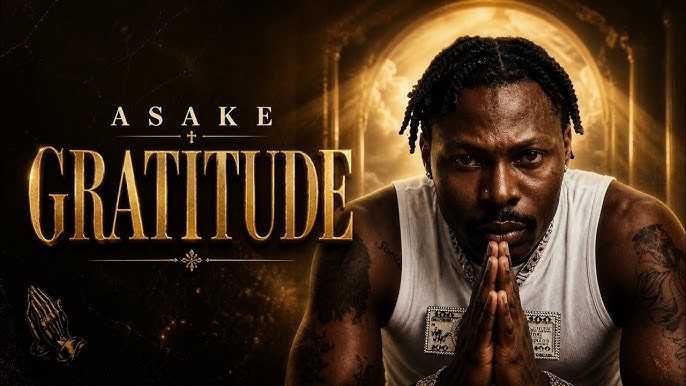
Asake – Gratitude
Asake – Gratitude” is one of those songs that immediately tells you what kind of emotional space its creator is in. Released on 30 April 2026 as part of his M$NEY album, the song moves away from simply celebrating material success and turns its attention towards survival, blessings, criticism, faith and the complicated journey that comes with becoming successful. At just about two minutes and fifty seconds, “Gratitude” does not waste much time getting to its central message, yet the simplicity of the song leaves enough room for listeners to attach their own experiences to it.
At the heart of “Gratitude” is a familiar Asake formula, but this time it feels more reflective. He combines his recognisable Afropiano sound with Yoruba musical sensibilities, spiritual undertones and a melody that feels almost like a personal conversation. The production is credited to Magicsticks, one of the producers who has played an important role in shaping the sound associated with Asake’s rise. The recording also features bass guitar, piano, guitar, saxophone, orchestra and choir contributions, giving the track a richer musical texture than its relatively short runtime might suggest.
What makes “Gratitude” interesting is that Asake does not approach gratitude from the perspective of someone who has never experienced hardship. Instead, he sounds like someone looking backwards after travelling a difficult road. The opening sentiment is essentially a declaration that he has seen a lot in his life. That immediately changes the interpretation of the song. This is not simply a celebration because money has arrived. It is a celebration because, in his view, he has survived enough to appreciate what has arrived.
That distinction matters.
Many Afrobeats songs celebrate money, luxury, women, cars, nightlife and social status. Asake himself has never been a stranger to themes of achievement and financial success. However, “Gratitude” places those ideas inside a broader emotional framework. The money is important, but it is not the entire story. The song repeatedly connects blessings with the experience of being criticised, misunderstood and judged by other people.
One of the most striking ideas in “Gratitude” is the recognition that people can overlook the good you have done and concentrate on your mistakes. Asake addresses this frustration directly, suggesting that no matter how much good a person does, there will always be people prepared to discuss the negative. That is an extremely relatable message in the age of social media, where a person can spend years building something meaningful only for one mistake, controversy or unpopular opinion to dominate public conversation.
The song therefore becomes bigger than Asake himself.
A young person struggling to build a career can hear “Gratitude” and interpret it as encouragement to keep going. Someone who has finally achieved financial stability can hear it as a reminder not to take that achievement for granted. Someone dealing with criticism can hear the song and recognise the frustration of trying to please everybody. Even someone who has never experienced fame can understand the underlying message because the desire for acceptance is universal.
Asake’s use of Nigerian Pidgin and Yoruba is also important. Rather than abandoning the linguistic identity that helped distinguish him from many of his contemporaries, he continues to build his music around the language, expressions and cultural rhythms that feel natural to him. The result is a song that can sound immediately accessible to Nigerian listeners while still carrying an emotional message that does not require the listener to understand every Yoruba phrase.
The phrase “it’s not personal” becomes particularly important to the song’s emotional direction. It sounds like advice from someone who has learned that taking every criticism personally can become exhausting. There is a certain maturity in that perspective. You cannot control what everybody thinks about you. You cannot control every rumour, every opinion or every interpretation of your actions. At some point, you have to decide what deserves your attention and what does not.
That is where “Gratitude” becomes more than a celebration song.
It becomes a survival song.
Asake’s career has moved at remarkable speed. His emergence as one of Nigeria’s biggest contemporary music stars was built around a distinctive combination of Afrobeats, amapiano, Fuji influences, Yoruba musical traditions and a strong visual identity. Earlier projects established a recurring interest in ambition, struggle, success and spirituality. Critics have previously noted how his music can combine amapiano rhythms with traditional Nigerian influences and themes of manifestation and achievement.
“Gratitude” feels like another chapter in that continuing story.
There is also something interesting about the song’s placement on M$NEY. The album itself contains explicitly spiritual material alongside songs dealing with money, relationships, identity and personal experience. “Gratitude” appears immediately after “WORSHIP” on the album tracklist, creating an interesting transition from direct spiritual expression into appreciation for blessings and survival. The tracklist also includes “Amen” and “Forgiveness”, reinforcing the broader spiritual vocabulary running through the project.
This positioning makes “Gratitude” feel deliberate rather than random.
The song seems to sit between prayer and celebration. It acknowledges where blessings come from while also acknowledging the realities of life after the blessing arrives. That is an important distinction because success does not automatically eliminate problems. In some cases, success simply changes the kind of problems a person has.
When you become visible, everybody has an opinion.
When you become wealthy, everybody notices.
When you become successful, people who never noticed you before may suddenly have something to say.
When you make mistakes, the audience becomes larger.
“Gratitude” captures some of that tension without becoming unnecessarily complicated.
Musically, the production is one of the song’s strongest elements. Magicsticks keeps the rhythm controlled rather than overwhelming the message. The instrumentation gives the track an almost celebratory spiritual quality, while the choir and orchestral contributions add a dimension that separates it from a straightforward club record. The official credits list Chineke! Orchestra, Melodees From Heaven, piano, guitar, bass and saxophone contributors alongside Asake.
That combination creates an interesting balance between modern Afropop and something more traditional and ceremonial.
Asake’s vocal delivery is also central to the song. He does not need to overcomplicate the performance. His voice carries the personality of the record, moving between melodic passages and conversational phrasing. That conversational quality is one of the reasons his music often feels personal even when the lyrics are dealing with broad themes.
There is an almost streetwise wisdom to the performance. Asake – Gratitude
He sounds like someone telling you, “I have seen enough to know that everybody will not like me, and I have decided to keep moving anyway.”
That message can resonate strongly with young Nigerians navigating career pressure, financial uncertainty, social expectations and the constant comparison created by social media.
Another notable aspect is the song’s relationship with faith. Asake has increasingly incorporated spiritual language and religious references into his music, and M$NEY places those themes prominently within the overall project. “Gratitude” does not read like a traditional gospel song, but it clearly borrows from the emotional vocabulary of thanksgiving. The references to Jesus, blessings and gratitude create a spiritual dimension without transforming the track into conventional worship music.
This mixture is very much in line with Asake’s artistic identity.
His music has frequently existed somewhere between the street, the club, traditional Yoruba expression and spirituality. That ability to occupy different cultural spaces is part of what makes him interesting as an artist.
However, “Gratitude” is not without weaknesses.
The biggest limitation is probably its brevity. At around two minutes and fifty seconds, the song makes its point quickly, but some listeners may feel that the concept could have been developed further. There are ideas here about fame, criticism, faith, survival and success that could easily support a longer and more lyrically detailed song. Instead, Asake chooses repetition and atmosphere over extensive storytelling.
That choice works for the mood, but it also means the song does not reveal as much as it potentially could.
Some listeners may also find the lyrics straightforward. There is no elaborate narrative structure or complicated lyrical puzzle to decode. The message is relatively direct. You have suffered, you have survived, people will criticise you, blessings have come, and you should remain grateful.
For some listeners, that simplicity will be the attraction.
For others, it may feel like the song leaves some emotional territory unexplored.
There is also a broader criticism that can be applied to M$NEY. Some critics have argued that the album occasionally prioritises atmosphere and accessibility over the unpredictability and depth that characterised some of Asake’s earlier work. Pitchfork, for example, described the album as less adventurous than his earlier material while noting that his familiar Afropiano, Fuji and jazz influenced sound remains present.
That criticism is worth considering when evaluating “Gratitude”, because the song does not necessarily represent a radical reinvention of Asake.
Instead, it represents refinement.
He knows the sound that works for him, and he continues to develop it.
For listeners who loved the distinctive musical world Asake established with projects such as Mr. Money With the Vibe and Work of Art, “Gratitude” should feel familiar. The difference is that the emotional emphasis has shifted. The focus is less on proving that he can succeed and more on acknowledging that he has already come a long way.
That is perhaps the most powerful aspect of the record.
Gratitude becomes especially meaningful when you remember the version of yourself that once prayed for what you now have.
People often become so focused on the next goal that they forget to appreciate the previous victory. They get the job and immediately want the promotion. They get the first car and immediately want a better one. They make their first million and immediately start chasing ten million. They become recognised and immediately start worrying about becoming more famous.
“Gratitude” challenges that mentality, even if indirectly.
Stop for a moment.
Look around.
Remember what you survived.
Remember what you prayed for.
Remember the doors that opened.
Remember the people who helped you.
Remember the version of yourself who would have been amazed by the life you currently consider ordinary.
That is where the title becomes particularly effective.
“Gratitude” is not merely the name of the song. It is the emotional instruction behind the song.
And perhaps that is why the record can work both as a personal listening experience and as a communal Afrobeats record. You can dance to it, but you can also reflect on it. You can enjoy the rhythm while thinking about your own journey.
That combination has always been one of Asake’s strengths.
Ultimately, Asake’s “Gratitude” is a reflective Afrobeats record built around appreciation, resilience, criticism, faith and the complicated reality of success. It is not his most lyrically ambitious song, nor does it attempt to reinvent his sound. Instead, it takes familiar Asake ingredients and places them inside a more thankful and introspective framework.
The song succeeds because its message is simple enough to understand but broad enough to personalise. Asake may be talking about his own journey, but listeners can easily insert their own experiences into the story.
The production gives the record warmth. The choir and instrumentation create a spiritual atmosphere. The Yoruba and Nigerian Pidgin expressions preserve Asake’s cultural identity. His vocal delivery remains unmistakable, and the recurring message about ignoring unnecessary negativity gives the song an additional layer of relevance.
More importantly, “Gratitude” reminds listeners that success should not erase memory.
If you have finally reached somewhere you once dreamed about, take a moment to appreciate it.
If people are criticising you despite your efforts, remember that you cannot please everyone.
If your life has changed dramatically, remember the struggles that made you appreciate the change.
And if the blessings have arrived, do not become so obsessed with the next blessing that you forget to say thank you for the current one.
That is ultimately what makes “Gratitude” an appealing addition to Asake’s catalogue. It is not necessarily a song that demands to be analysed endlessly. It is a song designed to be felt, repeated and lived with.
For fans of Asake, Afrobeats, Nigerian music and songs that combine celebration with reflection, “Gratitude” is worth adding to the playlist. It represents another side of an artist who has built much of his identity around ambition and achievement, while reminding listeners that sometimes the most powerful response to everything you have survived is simply appreciation.
Asake’s “Gratitude” is therefore less about showing the world what he has gained and more about acknowledging what it took to get there. In a culture where everybody is constantly chasing the next level, that message is surprisingly powerful.
Sometimes, you do not need another reason to complain.
Sometimes, you just need to look at how far you have come.
And be grateful.
Asake – Gratitude
Recommended: Earn From Your Phone
- Easy Dollar Maker — earn in dollars uploading AI images and videos from your phone ($17). Check it out
- Video Editing Blueprint for Beginners — learn video editing and start creating content ($10). Check it out
- CapCut Pro (Lifetime Access) — the pro video editor for your TikToks and music videos ($3.40). Check it out
Disclosure: These are affiliate links. If you buy through them, I may earn a commission at no extra cost to you.