DJ Khaled – LET IT GO ft. Justin Bieber, 21 Savage
The landscape of contemporary popular music frequently relies on the master coordination of high-profile orchestrators capable of assembling seemingly incompatible musical forces under a single commercial banner. Within this domain of curation, DJ Khaled has long operated as a polarizing yet undeniably successful bridge builder, a figure whose entire brand rests on the premise of sonic spectacle and star-studded synergy. When he brought together the pristine global pop sensibilities of Justin Bieber and the dark, street-oriented trap realism of 21 Savage for the track Let It Go, the industry received a fascinating study in contrast and deliberate market crossover. Serving as an explosive centerpiece from his twelfth studio album, Khaled Khaled, the track bridges a massive aesthetic gulf, wedding buoyant, breezy pop instrumentation with gritty hip-hop lyricism. This comprehensive critique deconstructs the structural composition, production intricacies, vocal friction, and strategic commercial architecture of Let It Go, exploring how it balances its competing creative forces to secure its place in modern pop-cultural history.
Musically, the song functions as an intentional exercise in sonic optimism and warmth, designed explicitly to invoke the carefree, sun-drenched atmosphere of Miami, Florida, which serves as the permanent spiritual and literal home of Khaled’s creative enterprise. The production, spearheaded by DJ Khaled alongside the brilliant multi-platinum hitmaker Al Shux, intentionally departs from the heavy, brooding, minor-key trap patterns that usually accompany a performance by 21 Savage. Instead, the track introduces an immediately inviting, mid-tempo groove built upon a bright, acoustic guitar loop that serves as the rhythmic spine of the entire composition. This organic element is paired with a crisp, driving percussion arrangement, characterized by rhythmic handclaps, a steady four-on-the-floor kick pattern, and a buoyant bassline that infuses the record with an undeniable feel-good bounce. The instrumentation is specifically engineered to evoke feelings of relief and personal freedom, utilizing bright sonic colors to establish an accessible auditory space that feels custom-built for high-rotation summer radio and premium daytime streaming.
The vocal architecture of Let It Go creates an intriguing study in dynamic contrast, utilizing the vast differences between its guest artists to prevent the track from falling into predictable formulaic patterns. Justin Bieber acts as the track’s melodic anchor and emotional engine, taking charge of the massive, anthemic chorus and the opening verse with an effortless, silky vocal delivery. Bieber operates completely within his comfort zone here, utilizing his upper register and subtle vocal runs to inject a sense of euphoric clarity into the record. His performance is marked by an infectious, soaring energy that leans into themes of spiritual surrender, emotional release, and moving past personal obstacles, providing the track with its essential pop mass appeal. By delivering a hook that is instantly memorable and easy to sing along with, Bieber guarantees that the song functions as a highly effective earworm capable of lodging itself in the public consciousness after a single listen.
When 21 Savage enters this bright, acoustic pop space, the track experiences a sudden, highly fascinating shift in gravity and emotional texture. Known globally for his monotone, cold delivery and vivid chronicles of street survival, the Atlanta-based rapper represents the absolute antithesis of Bieber’s pristine pop persona. Rather than attempting to alter his signature identity to fit the sunny disposition of the production, 21 Savage leans heavily into his classic, deadpan cadence, creating an immense amount of creative friction that gives the track its unique identity. He delivers his verse with a calm, deliberate precision, effortlessly blending his typical themes of loyalty, financial security, and street alertness with a surprisingly reflective, slightly softer perspective that matches the song’s underlying message of personal peace. This deliberate juxtaposition between Bieber’s soaring optimism and Savage’s grounded, percussive street rap prevents the song from becoming overly sentimental, offering an essential balance that keeps the composition multi-dimensional.
Lyrically, the song constructs a simple yet remarkably effective narrative centered around the concepts of personal liberation, resilience, and the active refusal to be weighed down by external negativity or past failures. The phrase let it go functions as both a literal command and a broader lifestyle philosophy, inviting listeners to discard toxic relationships, unnecessary stress, and internal doubts in pursuit of a higher peace of mind. Bieber’s lines focus on emotional clarity and moving forward with confidence, while 21 Savage pivots the narrative toward financial independence and moving beyond the systemic struggles of his upbringing. This dual lyrical approach allows the song to speak simultaneously to two completely different subsets of listeners, offering a generic message of emotional wellness on one hand, while speaking to a deep, survivalist desire for worldly success and peace on the other, wrapped neatly inside an uplifting pop packaging.
The overarching structure of the track is carefully engineered to maintain an incredibly high level of momentum, ensuring that the contrasting styles of the performers merge seamlessly rather than feeling like a disjointed assembly of individual parts. DJ Khaled’s trademark ad-libs and enthusiastic vocal interjections serve as a unifying thread throughout the duration of the track, acting as a hype-man who continuously reminds the listener of the historic nature of the collaboration. The transition from Bieber’s smooth, soaring pre-chorus into 21 Savage’s grounded rap verse is executed with a high degree of technical finesse, allowing the acoustic guitar loop to bridge the gap between pop melody and hip-hop rhythm without causing an abrupt or jarring disruption to the established listening experience. This meticulous attention to pacing keeps the track feeling remarkably tight and cohesive across its entire running time.
From a strategic market perspective, Let It Go represents a brilliant piece of cross-demographic commercial engineering, specifically designed by DJ Khaled to maximize chart dominance and dominate various digital streaming algorithms simultaneously. By combining the unparalleled pop and R&B streaming power of Justin Bieber with the immense hip-hop credibility and cultural currency of 21 Savage, the record was perfectly positioned to conquer multiple distinct Billboard charts upon its initial release. The track is configured to appeal to an exceptionally wide array of demographics, supplying mainstream pop radio with an uplifting summer anthem while offering urban contemporary and rhythmic formats a credible rap collaboration. This expansive approach allowed the single to effortlessly slip onto high-traffic mood playlists, workout sequences, and global party curation boards, securing massive streaming totals and a highly visible footprint across the modern music ecosystem.
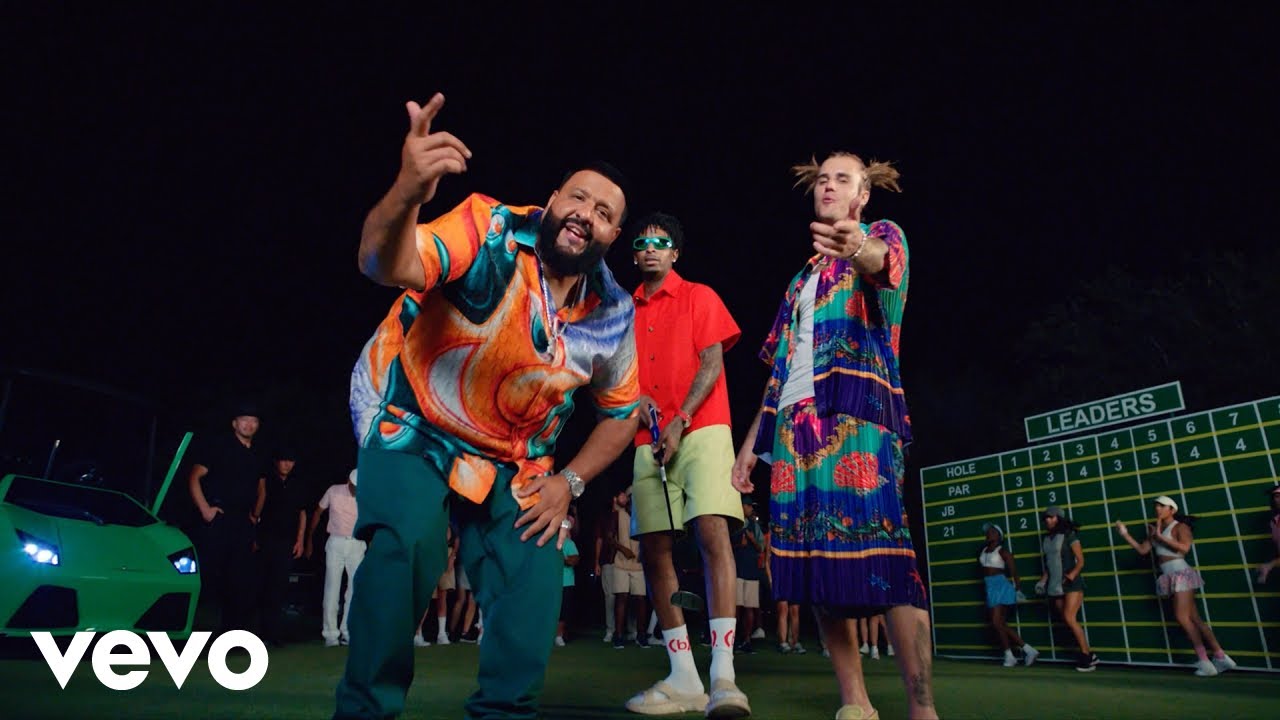
The visual representation of the track, directed by the acclaimed filmmaker Colin Tilley, serves as a crucial, highly entertaining extension of the song’s playful, high-energy philosophy, significantly elevating its cultural impact. Heavily inspired by classic cinematic slapstick and the iconic sports film Happy Gilmore, the music video depicts DJ Khaled, Justin Bieber, and 21 Savage participating in a chaotic, high-stakes golf tournament. The visual narrative leans into humor and absurd scenarios, featuring Khaled wrestling an alligator on the green while Bieber showcases dramatic golf swings and 21 Savage maintains his signature stoic expression while riding a customized golf cart. By choosing a lighthearted, comedic concept over a traditional, hyper-stylized luxury rap aesthetic, the visual team masterfully amplifies the song’s themes of relaxation and letting go of serious tension, humanizing these global icons and giving the public a memorable visual package that demands repeat viewings.
The technical mixing and mastering of Let It Go deserve significant recognition for their flawless execution, managing a complex blend of live acoustic elements and heavy electronic percussion with absolute clarity. The engineering team balances the mix beautifully, ensuring that the bright strumming of the acoustic guitar remains prominent and crisp without getting buried beneath the booming low-end frequencies of the kick drums and bassline. Bieber’s vocals are treated with a pristine, polished clarity that highlights the natural warmth of his tone, while 21 Savage’s verse is mixed to sound incredibly direct, heavy, and present in the center of the audio field. Every ad-lib, background vocal swell, and percussive roll is placed with deliberate intentionality across the stereo image, resulting in a rich, high-fidelity auditory experience that translates perfectly across cheap phone speakers and massive nightclub sound systems alike.
In the broader context of DJ Khaled’s extensive, hit-filled discography and his unique legacy within popular music culture, Let It Go stands out as a definitive example of his uncanny ability to function as a highly effective pop-art curator. The track proves that his true genius lies not in traditional music production, but in an advanced, highly intuitive understanding of human chemistry and market dynamics, knowing exactly which distinct creative worlds to collide to produce maximum cultural impact. It stands as a testament to the evolving nature of modern music, where traditional boundaries between street-oriented hip-hop and mainstream global pop have completely collapsed, allowing for hybrid creations that can satisfy hardcore rap fans and casual pop listeners in equal measure. The song perfectly encapsulates the spirit of the streaming era, where star power, infectious rhythm, and an unshakeable sense of optimism are synthesized into a highly lucrative global product.
Ultimately, Let It Go by DJ Khaled, Justin Bieber, and 21 Savage remains a highly successful, brilliantly executed milestone of contemporary collaborative music that continues to resonate across the global landscape. Every single component of the track, from the sun-kissed, guitar-driven bounce of the production to the fascinating vocal friction between the lead artists and the comedic brilliance of its cinematic music video, works in complete alignment to deliver a powerful message of joy and resilience. It serves as a striking reminder that the most compelling popular art often emerges from unexpected places, demonstrating that when elite masters of completely different musical spaces unite with a collective sense of fun, they can transcend industry expectations and create something truly memorable. For anyone looking to study the mechanics of cross-genre appeal, commercial durability, and high-level collaborative synergy in modern pop, this star-studded track remains an essential case study.
DJ Khaled – LET IT GO ft. Justin Bieber, 21 Savage
Recommended: Earn From Your Phone
- Easy Dollar Maker — earn in dollars uploading AI images and videos from your phone ($17). Check it out
- Video Editing Blueprint for Beginners — learn video editing and start creating content ($10). Check it out
- CapCut Pro (Lifetime Access) — the pro video editor for your TikToks and music videos ($3.40). Check it out
Disclosure: These are affiliate links. If you buy through them, I may earn a commission at no extra cost to you.