
Injustice – Season One – Episode One
Injustice Season One, Episode One Review
There are some movies and television series that begin by giving you all the answers. Injustice does the opposite. From the opening episode, the 2011 British psychological thriller creates an atmosphere of uncertainty, guilt, suspicion and unanswered questions that immediately makes you wonder how much you can trust the people you are watching.
Injustice – Season One, Episode One introduces us to William Travers, played by James Purefoy, a successful criminal barrister who appears to have deliberately walked away from the stressful world of London murder cases. Travers is now living a relatively quiet life in the Suffolk countryside with his wife, Jane, and their daughter. On the surface, he seems to have found the peaceful family life that many people would desire. But the peace does not last.
His past comes knocking when his old friend Martin Newall is accused of murdering his secretary and lover. Martin maintains his innocence, and Travers is asked to defend him. This is where the central conflict of the episode begins. Travers is not simply taking on another legal case. He is being forced to return to a world that he and his family had apparently left behind for a reason.
What makes the situation particularly interesting is the relationship between Travers and the legal system. He is a man who understands the law extremely well, but the episode makes it clear that his confidence in the justice system has been damaged by previous experiences. This gives the story more depth than a conventional murder investigation. The question is not simply, “Did this person commit the crime?” It is also, “Can the truth actually survive inside a system that is supposed to deliver justice?”
That question is one of the strongest elements of Episode One.
The episode also introduces a second murder investigation. A local farm worker, John Jarrold, is found dead near Travers’s home, and Detective Wenborn becomes involved in the investigation. Rather than keeping the story focused exclusively on Martin’s murder case, the writers begin building two separate mysteries that gradually appear capable of intersecting.
This structure works particularly well because it prevents the episode from becoming predictable. Just when you begin to settle into Travers’s courtroom story, the investigation surrounding the local killing introduces another layer of tension.
(EPISODE 1) – DOWNLOAD NOW
Detective Wenborn is also an important addition to the story. His investigation does not feel like a simple police subplot. There is a personal element to his pursuit of the truth, and his presence creates another source of pressure for Travers. The contrast between the barrister and the detective is particularly interesting. One works within the courtroom, while the other works through investigation. Both are supposedly searching for the truth, but they approach that truth from very different directions.
The episode’s greatest strength, however, is its atmosphere.
Injustice is not the type of thriller that needs constant explosions, dramatic action sequences or exaggerated confrontations to create tension. Instead, it relies on conversations, facial expressions, uncomfortable silences and the gradual revelation of information. The result is a much slower but more psychological form of suspense.
There is a feeling throughout the episode that something is wrong, even when nothing obviously dramatic is happening.
That is what makes the title Injustice particularly appropriate. The story is already asking difficult questions about guilt, innocence and the limitations of the justice system. A person can be accused of murder, but an accusation is not the same thing as guilt. At the same time, defending someone does not necessarily mean the lawyer knows everything about that person’s actions.
This creates an uncomfortable moral problem for William Travers.
As a defence barrister, his responsibility is to represent his client. But what happens when the person you are defending may not be telling you the whole truth?
That question gives the series its psychological foundation. According to the series description, Travers is a barrister recovering from traumatic events that have shaken his belief in the legal system. The broader story is built around murder, conspiracy, secrets and guilt.
James Purefoy does a good job portraying Travers as a man who is intelligent and composed on the outside but clearly carrying emotional baggage underneath. He does not need to explain everything through long speeches. Much of the character’s history is communicated through his reactions to situations and through the way other characters respond to him.
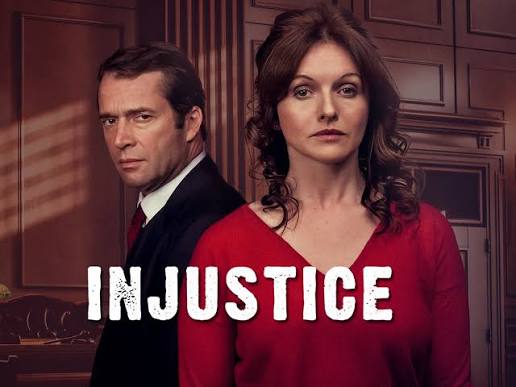
Dervla Kirwan, who plays Jane Travers, also contributes to the tension because Jane is not simply a character standing beside her husband’s storyline. She represents the family life Travers is putting at risk by returning to the world he tried to escape. His decision to accept Martin’s case therefore has consequences beyond the courtroom.
One of the most realistic aspects of the episode is that Travers’ professional decision is not treated as something that affects only him. His wife understands what returning to London and taking on the case could mean. Their previous experiences have already left scars, so his decision naturally creates tension within the family.
The episode also succeeds because it does not rush to explain everything.
Some viewers may find the pace slower than modern crime dramas, especially if they are accustomed to shows that reveal a new twist every few minutes. But the slower pace is part of Injustice’s identity. Episode One is essentially laying the foundation for a much larger mystery.
The episode lasts roughly 44 to 47 minutes depending on the listed version, and it uses that time to introduce the major characters, establish Travers’ history, introduce the murder case and begin the investigation into the local killing.
(EPISODE 1) – DOWNLOAD NOW
There is also something refreshing about the fact that the story does not immediately tell the audience whom to trust.
Martin says he is innocent.
Travers has his own reasons for believing certain things.
The police have their own investigation.
And the audience is left somewhere in the middle, trying to work out what is actually happening.
That uncertainty is where the suspense comes from.
Another strength is the way the episode explores the difference between legal truth and actual truth. In a courtroom, the question may be whether the prosecution can prove its case beyond the required legal standard. But outside the courtroom, human beings are often dealing with a much messier version of truth.
Someone can look innocent and still be guilty.
Someone can look suspicious and still be innocent.
And sometimes the people searching for justice can make mistakes themselves.
That is the territory Injustice begins exploring.
The title therefore feels less like a reference to one particular crime and more like a question about the entire system. What happens when justice fails? What happens when the wrong person is accused? What happens when someone who is supposed to defend the truth becomes uncertain about what the truth actually is?
These questions make Episode One more intellectually engaging than a straightforward murder mystery.
The biggest criticism one could make of the episode is its deliberate pacing. Viewers looking for immediate action may feel that the story takes too long to develop. Some characters and mysteries are introduced without immediate explanation, which may initially feel confusing.
However, that confusion appears intentional. The episode is designed to make the viewer ask questions rather than answer them.
(EPISODE 1) – DOWNLOAD NOW
And that is probably the best way to approach Injustice. Do not watch Episode One expecting everything to make sense immediately. Watch it as the opening piece of a larger puzzle.
Overall, Season One, Episode One is a strong introduction to the series. It establishes William Travers as a complicated protagonist, introduces a murder case with serious personal consequences, creates a second mystery through the death of John Jarrold, and places the characters inside a world where truth, guilt and justice are not always as straightforward as they appear.
What makes the episode particularly effective is that it does not simply ask whether someone committed a crime. It asks a much more uncomfortable question: What happens when the people responsible for delivering justice are forced to confront the possibility that justice itself may have failed?
That question gives Injustice its identity.
Episode One may not be the kind of thriller that grabs you by the throat with constant action, but it quietly gets inside your head. By the time the episode ends, you are left with enough unanswered questions to make the next episode feel necessary.
And perhaps that is exactly what a good first episode should do.
It should not give you the entire story.
It should make you want to find out what happens next.
(EPISODE 1) – DOWNLOAD NOW
Recommended: Earn From Your Phone
- Easy Dollar Maker — earn in dollars uploading AI images and videos from your phone ($17). Check it out
- Video Editing Blueprint for Beginners — learn video editing and start creating content ($10). Check it out
- CapCut Pro (Lifetime Access) — the pro video editor for your TikToks and music videos ($3.40). Check it out
Disclosure: These are affiliate links. If you buy through them, I may earn a commission at no extra cost to you.