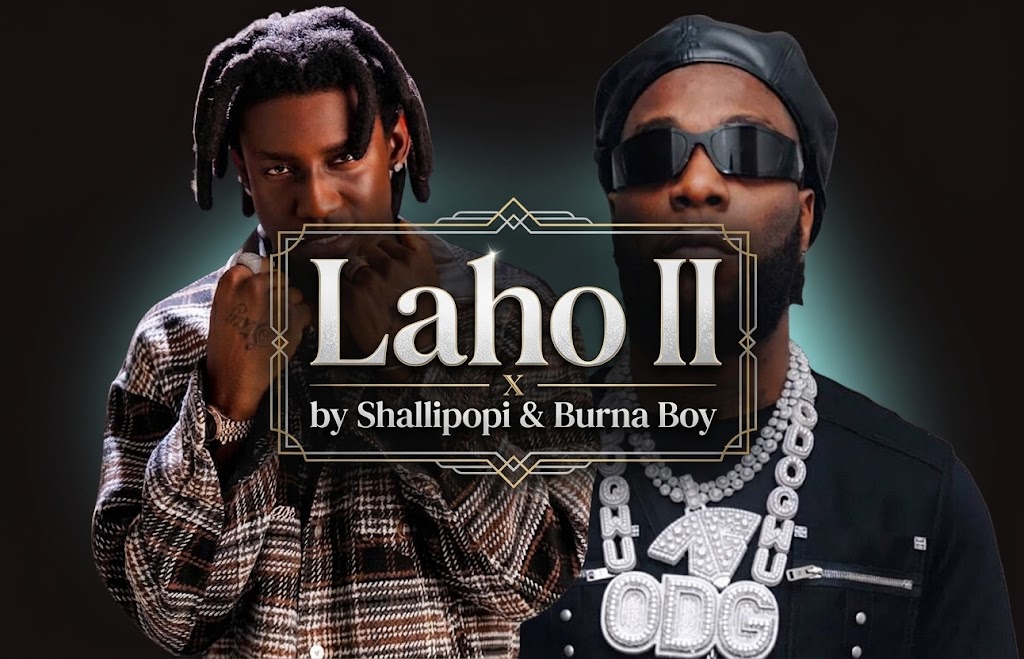
Laho II by Shallipopi & Burna Boy
Laho II by Shallipopi & Burna Boy is the kind of Afrobeats collaboration that does not need a complicated introduction before it gets moving. From the opening seconds, Shallipopi brings his unmistakable Benin rooted energy, while Burna Boy eventually enters with the commanding confidence that has become one of the defining characteristics of his music. The result is a short, energetic and highly replayable record that combines street credibility, African identity, money talk, confidence and pure enjoyment into one compact package. Released on 25 April 2025, Laho II by Shallipopi & Burna Boy quickly established itself as one of the most talked about collaborations surrounding Shallipopi’s growing catalogue. The song was released under Since 93 under exclusive licence from Plutomania Records and was produced by Progrex.
Laho II by Shallipopi & Burna Boy is particularly interesting because it does not feel like a collaboration created simply because two popular Nigerian artists needed to appear on the same record. There is a clear connection between the energy of Shallipopi and the personality of Burna Boy. Both artists have built careers around individuality, confidence and an ability to make African street culture sound commercially attractive without completely removing the character that made it popular in the first place.
The song is essentially an expanded version of the world created around Shallipopi’s original “Laho”. Instead of completely abandoning the identity of the original record, Laho II builds on its foundation by bringing Burna Boy into the conversation. That decision is important because Shallipopi’s music has always depended heavily on personality. His unusual vocal delivery, Benin references, slang and carefree attitude are part of what separates him from many other contemporary Afrobeats artists. Rather than trying to make him sound more conventional, Laho II allows those characteristics to remain at the centre of the record.
One of the first things listeners will notice about Laho II by Shallipopi & Burna Boy is the production. Progrex creates a rhythm that is energetic without becoming unnecessarily complicated. The instrumental gives the vocals enough space to dominate while maintaining the bounce required for clubs, parties, street playlists and social media content. The production is not trying to prove how technically complex it can be. Instead, it understands the most important requirement of a song like this: it needs to make people move.
That simplicity is actually one of the strengths of Laho II. Afrobeats has increasingly become a global genre, and there can sometimes be pressure for songs to become overly polished for international audiences. Laho II goes in another direction. It retains a distinctly Nigerian personality. There is a looseness to the record that makes it feel connected to the streets rather than manufactured exclusively for international playlists.
Shallipopi’s performance is central to that feeling. His delivery is immediately recognisable, and he sounds completely comfortable inside the production. He does not attempt to imitate Burna Boy, nor does he reduce his personality simply because a heavyweight guest has joined the record. Instead, Shallipopi remains Shallipopi. That may sound obvious, but it is one of the reasons the collaboration works so well.
The opening section establishes the mood quickly. Shallipopi presents himself as a larger than life character surrounded by attention, money, women, alcohol and the lifestyle associated with rising fame. There is humour in the way he approaches these subjects, but there is also a sense of self celebration. His lyrics are less about telling a complicated story and more about creating an atmosphere.
That atmosphere becomes even stronger when the hook arrives. The repeated “Laho” phrase gives the record its identity and makes the chorus extremely easy to remember. It is the type of hook that can survive outside the full song because it does not require listeners to remember an entire verse. Once the rhythm starts, the repeated phrase becomes almost hypnotic.
Burna Boy’s entrance changes the character of the song without destroying what Shallipopi has already established. His deeper vocal tone provides contrast to Shallipopi’s more playful delivery. This difference between their voices is one of the most effective elements of the collaboration. Instead of sounding like two artists competing for the same space, they occupy different parts of the record.
Burna’s verse also brings a more serious form of confidence into the song. While Shallipopi focuses heavily on enjoyment, lifestyle and his street identity, Burna approaches the record with warnings about loyalty, money, boundaries and people who may try to take advantage of success. His contribution therefore gives the song another layer without changing its fundamental mood.
The lyrical content of Laho II is not particularly interested in deep storytelling. That is not necessarily a weakness. This is a vibe driven record, and its purpose is largely to entertain. The song revolves around money, enjoyment, status, confidence and the ability to live without allowing other people’s opinions to determine your behaviour.
There is also a strong sense of place throughout the record. Shallipopi’s Benin identity is not treated as something that needs to be hidden in order to achieve mainstream success. Instead, it becomes part of the music’s appeal. References connected to Benin and places associated with his background help reinforce the idea that the artist has carried his roots with him even as his profile has expanded.
This is one of the most important things about Shallipopi’s rise. His music has shown that an artist can bring highly local expressions and cultural references into mainstream Nigerian music without necessarily translating every detail for everyone. Listeners may not understand every expression immediately, but the emotion, rhythm and confidence remain accessible.
Laho II by Shallipopi & Burna Boy therefore becomes more than a straightforward remix. It is also a meeting between two generations of Nigerian music success. Burna Boy represents an artist who transformed local Nigerian musical identity into a globally recognised brand, while Shallipopi represents a younger generation building its own version of that journey through internet culture, street energy and distinctive regional identity.
The collaboration is particularly interesting because Burna Boy does not overshadow Shallipopi. Whenever a younger artist collaborates with an established superstar, there is always a risk that the guest will dominate the record. Here, however, the song still feels like a Shallipopi record. Burna Boy adds weight to it, but he does not completely take control of its identity.
That balance is important. Laho II would probably not have worked as well if Shallipopi’s personality had disappeared beneath Burna Boy’s star power. Instead, the song feels like Burna Boy has entered Shallipopi’s world for a few minutes. That gives the collaboration a more authentic character.
The short runtime also deserves attention. At roughly two minutes, Laho II is incredibly concise. There is very little unnecessary material, and the song moves quickly from one section to another. For modern listeners with increasingly short attention spans, this can be a significant advantage. The record gets into its central idea almost immediately and leaves before the listener has much opportunity to become tired of it.
At the same time, the short runtime can also be viewed as the song’s biggest limitation. Some listeners may feel that the collaboration ends just as the chemistry between the two artists becomes more interesting. Burna Boy’s verse creates another dimension, and there is an argument that a slightly longer arrangement could have allowed both artists to explore that chemistry further.
Still, the decision to keep the song short makes sense from a replay perspective. Laho II does not demand a large time commitment. You can play it once, immediately play it again and still feel like you have not spent much time listening. That quality can be particularly valuable in the streaming era, where replay value is an important part of a song’s life.
Another strength of Laho II by Shallipopi & Burna Boy is its ability to move between different Nigerian linguistic and cultural expressions. English, Nigerian Pidgin, Edo influenced expressions and Yoruba references appear within the record’s broader cultural framework. This gives the song a distinctly Nigerian identity while still making its central themes easy to understand.
The song also demonstrates how contemporary Nigerian artists increasingly treat regional identity as an asset rather than a limitation. Shallipopi does not have to remove the Benin element from his music to collaborate with Burna Boy. In fact, that identity is part of what makes the collaboration interesting.
There is a bigger story behind this as well. Shallipopi’s rise from viral success to established artist has been remarkably fast. His breakout period brought him significant attention, and his Pluto identity became a major part of his artistic branding. By the time Laho II arrived, he was no longer simply an emerging artist hoping for recognition. He was already becoming one of the recognisable voices of a younger Nigerian music generation.
The appearance of Burna Boy on the song therefore feels symbolic. It suggests a passing of attention between an established African superstar and a younger artist who is building his own lane. It is not literally a transfer of power, but it demonstrates that Shallipopi has reached a level where major artists can enter his musical universe without the collaboration feeling strange.
The song eventually became part of Shallipopi’s 2025 album Auracle, where it appears near the closing stretch of the project. Premium Times described Laho II as a powerful and fiery remix and identified it as one of the album’s standout moments. That placement makes sense because the record carries the celebratory energy associated with the later part of the album.
If there is one area where Laho II may divide listeners, it is the lyrical depth. Anyone looking for a deeply introspective record about love, loss, politics or personal trauma is unlikely to find it here. This is not that kind of song. Its purpose is entertainment, confidence and movement. Judging it by the standards of a deeply reflective Afrobeats record would therefore miss what it is attempting to accomplish.
The lyrics are deliberately conversational and boastful. Shallipopi celebrates his lifestyle and status, while Burna Boy reinforces themes of money, self respect and boundaries. The result is a record that sounds more like a conversation between two confident personalities than a traditional narrative song.
This is also why the chemistry between the artists matters more than lyrical complexity. Listeners are likely to remember the sound of their voices together, the infectious hook and the overall attitude of the record before remembering individual lines. That is not necessarily a criticism. Some songs are designed to be analysed, while others are designed to be experienced.
Laho II belongs firmly in the second category.
The production also deserves credit for understanding the importance of space. Shallipopi’s unusual vocal style needs room to breathe, while Burna Boy’s heavier voice needs enough instrumental depth to carry its weight. Progrex manages to create a foundation where both artists can sound distinct. Apple Music credits Progrex as the producer, with D R O handling mixing and Junior Osei Agyepong handling mastering.
From a playlist perspective, Laho II is extremely versatile. It can fit naturally into Afrobeats playlists, Nigerian party playlists, gym playlists, driving playlists and social media sound selections. Its energy makes it particularly suitable for situations where the listener is not necessarily looking for complicated music but wants something that immediately changes the mood.
It also has the type of hook that can encourage audience participation. The repeated chorus gives listeners something easy to shout along to, while the contrasting verses provide enough variation to keep the track moving.
For Burna Boy, the song shows that he can step into a younger artist’s world without losing his own identity. For Shallipopi, it demonstrates that his sound can accommodate one of Africa’s biggest contemporary music stars without becoming unrecognisable.
That may ultimately be the biggest achievement of Laho II by Shallipopi & Burna Boy. It sounds like a collaboration rather than a competition. Neither artist needs to prove that he is more important than the other. Shallipopi brings the youthful street energy, regional identity and playful confidence, while Burna Boy brings experience, authority and an unmistakable vocal presence.
The result is not a song designed to change the entire direction of Afrobeats. It is something more straightforward and, in some ways, more useful. It is a highly replayable record designed to make people enjoy themselves.
Laho II by Shallipopi & Burna Boy succeeds because it understands exactly what it wants to be. It is energetic, confident, culturally grounded and deliberately uncomplicated. The production gives both artists enough room to shine, the chorus is instantly memorable, and the contrast between Shallipopi’s youthful delivery and Burna Boy’s commanding presence gives the song its strongest musical quality.
Its biggest weakness is also its biggest strength. The song is so short and focused on immediate enjoyment that listeners looking for greater lyrical depth or a more developed musical structure may feel that there is more potential left unexplored. But for a record designed around energy, replay value and personality, that brevity works surprisingly well.
Ultimately, Laho II by Shallipopi & Burna Boy is a strong example of what happens when two distinctive Nigerian voices meet without either artist abandoning his identity. It celebrates money, confidence, enjoyment, street culture and personal pride while maintaining a distinctly Nigerian character. Shallipopi sounds completely at home, Burna Boy adds veteran authority, and Progrex provides the rhythmic foundation that holds everything together.
Whether you listen to it for the beat, the hook, the Benin references, Burna Boy’s verse or simply the infectious energy, Laho II is difficult to ignore once it starts playing. It may not be the most complicated song in either artist’s catalogue, but it does not need to be. Its purpose is to entertain, and on that front, Laho II by Shallipopi & Burna Boy delivers with confidence.
For fans of contemporary Afrobeats, Nigerian street music and high energy collaborations, Laho II deserves a place on the playlist. It is short, catchy, culturally expressive and packed with the kind of personality that makes Nigerian music continue to stand out on the global stage.
Laho II by Shallipopi & Burna Boy
Recommended: Earn From Your Phone
- Easy Dollar Maker — earn in dollars uploading AI images and videos from your phone ($17). Check it out
- Video Editing Blueprint for Beginners — learn video editing and start creating content ($10). Check it out
- CapCut Pro (Lifetime Access) — the pro video editor for your TikToks and music videos ($3.40). Check it out
Disclosure: These are affiliate links. If you buy through them, I may earn a commission at no extra cost to you.